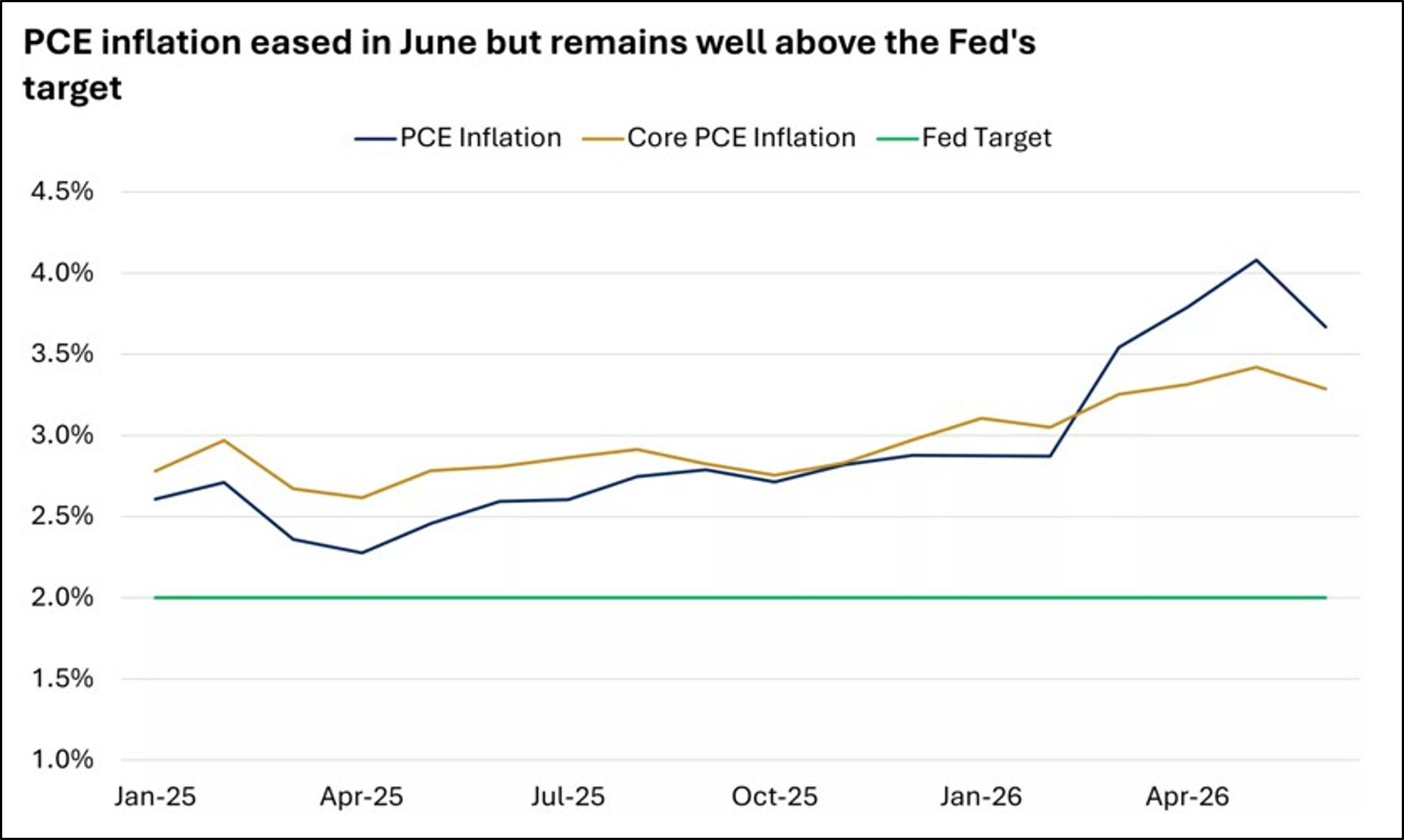
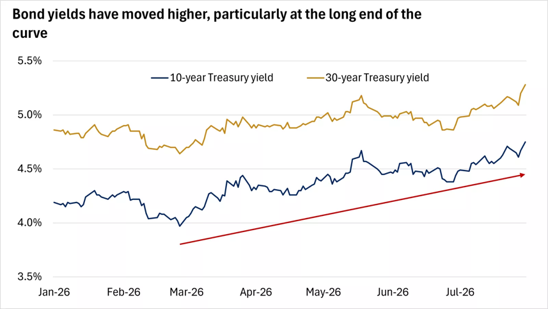
August 2026 was a month defined by two powerful and competing narratives. The first was a continuation of the cautionary equity story that has defined much of H22026: historically elevated valuations, a Federal Reserve that not only held its benchmark rate unchanged but registered three dissenting votes in favor of an immediate rate hike, and an increasingly bifurcated earnings landscape in which AI infrastructure compounders diverged sharply from a broader market under fundamental stress. Long-term Treasury yields pressed near multi-decade highs throughout the month, with the 30-year reaching 5.27% and the 10-year touching 4.73%, as U.S. gross debt crossed the $40 trillion threshold for the first time and the labor market deteriorated materially: July payrolls declined 23,000 against consensus expectations of a 90,000 gain, driving the three-month average to just 20,000 new jobs per month (a sharp reversal from March’s 214,000). Second-quarter GDP slowed to an annualized 1.5%, below the prior quarter’s 2.1% and below consensus, while the Fed’s preferred inflation gauge – the PCE Price Index – held at 3.7% year-on-year in both June and July. Chair Kevin Warsh’s Jackson Hole address on August 28 reinforced the policy message unambiguously, warning that the FOMC “must be confident that underlying inflation is moving to our objective, clearly and at sufficient speed.” The second narrative was the first material breakthrough in the Iran de-escalation process, which began to reshape the global macro-outlook in ways carrying far-reaching implications for energy prices, inflation dynamics, interest rate trajectories, and the relative performance of sectors and geographies that had become deeply mispriced by the prevailing consensus. For the month, the SCP 500 closed at 7,686, an increase of 2.62% from July’s close of 7,490. The Nasdaq Composite rose 4.18% to 29,457, as well as the Dow Jones Industrial Average by 1.34% to 53,186. Headline numbers, as so often in this market, concealed a far more volatile and instructive intramonth experience.
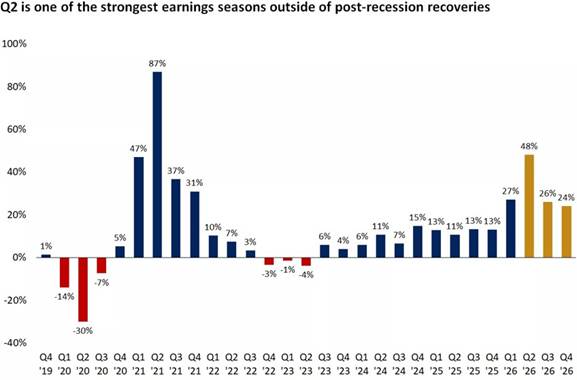
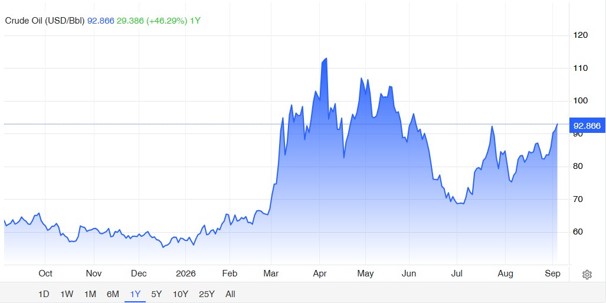
The month unfolded in three distinct acts. First, early August delivered a hawkish policy shock alongside fresh geopolitical escalation: the Fed held rates but three members dissented in favor of hikes, sending the 30-year yield above 5.20% and the 10-year to 4.71%, near their highest levels in nearly two decades. Simultaneously, renewed tensions around Iran’s nuclear Programme drove oil prices sharply higher. U.S. crude had briefly traded above $92 per barrel as recently as July 23 before falling back toward $78 by early August while triggering a flight to safe-haven assets that drove Gold to a new intramonth high of $4,670.90 per ounce on August 25, up from as low as $4,000 in mid-July. Compounding the macro backdrop, Treasury Secretary Bessent announced a doubling of the bond buyback Programme to $4 billion per session targeting the 10-, 20-, and 30-year segments, in a direct effort to ease longer-term borrowing costs. Second, diplomatic channels opened with unprecedented speed: back-channel communications between Gulf intermediaries, European officials, and Tehran produced credible signals of a ceasefire framework by mid-August, triggering an immediate collapse in the energy risk premium, a sharp fall in Brent crude toward the $76-78 range, and the beginnings of a meaningful disinflationary impulse that bond markets repriced within hours. Third, strong earnings confirmations from key AI infrastructure names reinforced the selective, dispersion-driven thesis for H22026: Q2 SCP 500 earnings growth was ultimately revised to 50.4% (the strongest quarterly rate since Q2 2021 and a dramatic upgrade from the 23.1% forecast at end-June) with Marvell Technology (MRVL) and Coherent Corp (COHR) among the standout
performers, underscoring the case to own quality AI infrastructure and resist the temptation to chase broad beta at 24x forward earnings.
We remain emphatically cautious on broad equity markets at these levels and reiterate our core conviction: the risk reward is deeply asymmetric to the downside of the market as a whole. The macro backdrop reinforces this view across multiple dimensions. The Fed, far from pivoting, is actively debating additional tightening: Warsh’s Jackson Hole address drove the 2-year yield to 4.35% in the immediate aftermath, small-cap stocks bore the brunt of the hawkish repricing with the Russell 2000 falling 1.4% on the day, and consumer sentiment deteriorated further to 51.7 on the University of Michigan’s Index in August (from 55.2 in July), reflecting the compounding burden of persistently elevated rates – with 30-year fixed mortgage rates rising for a fifth consecutive week to 6.69%. In parallel, VIX’s intraday fall to a year-to-date low of 14.1 by month-end speaks to a degree of market complacency that, in our view, materially underweights the structural risks embedded in the current macro and policy configuration. However, August crystallized a specific and actionable asymmetric opportunity that warrant structured positioning: not broad equity risk, but targeted, instrument, specific exposure implemented through structured notes and highly selective cash equity positions in underweight names with fundamental backing independent of the macro cycle. Structured note opportunities across Centene Corp (CNC), Arista Networks (ANET), Delta Air Lines (DAL), and LVMH – alongside direct equity consideration in LVMH, MRVL, and COHR – represent the most compelling risk-adjusted opportunities identified in our August review.
Macroeconomic Review
The August macroeconomic narrative was driven by a sequence of compounding data points that collectively painted a picture of an economy losing momentum against vs. persistently elevated inflation and a Federal Reserve that has moved towards a – surprisingly – more hawkish direction. The month opened with the Fed’s August policy meeting, at which the FOMC voted to hold its benchmark rate unchanged – but three voting members dissented in favor of an immediate rate hike, the most hawkish signal in the current cycle. Bond markets reacted immediately: the 30-year Treasury yield surged to 5.31% in the wake of the meeting and Chair Warsh’s press conference, closing the month at 5.25%, while the 10-year reached 4.75% – both near their highest levels in nearly two decades. The economic data released through August did nothing to ease the policy pressure. Second-quarter GDP growth came in at an annualized 1.5%, below the prior quarter’s 2.1% and below consensus, with federal spending and inventories acting as a drag. The Fed’s preferred inflation gauge, the PCE Price Index, showed annual inflation at 3.7%, slightly above economists’ expectations and well above the 2% target. August’ CPI reading, at 3.8% YoY, continued to show disinflation in progress but offered no grounds for complacency. The labor market added a further layer of concern: July payrolls declined 23,000 against consensus expectations of a +90,000 gain, with prior months revised down by a combined 103,000, leaving the three-month average at just 20,000 new jobs per month, a dramatic reversal from March’s 214,000. On the fiscal side, U.S. gross debt crossed the $40 trillion threshold for
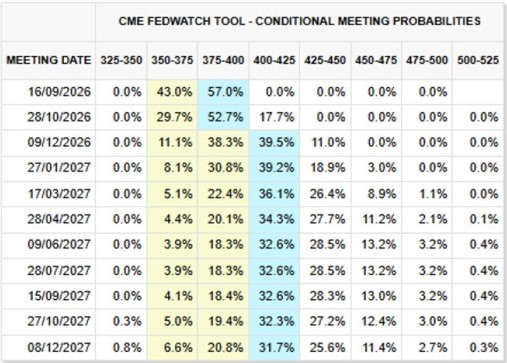
the first time during the month, prompting Treasury Secretary Bessent to announce a doubling of the bond buyback Programme to $4 billion per session targeting the 10-, 20-, and 30-year segments, in a bid to ease longer-term borrowing costs. The yield pressure was not isolated to the U.S.: Japan’s 10-year bond yield climbed to its highest level in approximately three decades, and Germany’s 30-year yield rose to its highest since 2011. At Jackson Hole on August 28, Warsh delivered the clearest policy signal of the month, stating that the FOMC “must be confident that underlying inflation is moving to our objective, clearly and at sufficient speed. Otherwise, we have work to do.” The next scheduled FOMC meeting on September 16-17 FOMC meeting is now the primary focal point, with futures markets pricing approximately a 57% probability of a 25bp hike.
Fixed Income
August brought the first meaningful relief to bond markets since the beginning of the hawkish cycle under Chair Warsh. The benchmark 10-year U.S. Treasury yield rose from 4.67% at the end of July to 4.75% at month-end, driven by U.S. public debt historic peak and Warsh tone more hawkish than expected. The 30-year bond yield rose to 5.25% from 5.21%, reflecting ongoing fiscal premium concerns and softening foreign demand.
The 2s10s spread was positive (un-inverted) throughout August 2026, fluctuating between +39 and +53 basis points. The 5s30s spread widened aggressively in August 2026. The long end of the curve experienced a massive selloff driven by heavy fiscal deficit spending, inflation fears, and potential geopolitical shock in the Strait of Hormuz. Unlike the intermediate tenors (5-year), which were anchored by predictable near-term monetary horizons, the 30-year bond suffered from a collapsing term premium. Investors demanded higher yields to absorb massive federal deficits and corporate debt issuance.
In this bear-steepening, high-volatility regime driven by hawkish Fed language, a geopolitical oil shock, and expanding fiscal deficits, we maintain our fixed income portfolio with an underweight duration bias, an emphasis on shorter curve and defensive corporate credit selection. The 5-year maturity provides the optimal risk-reward balance in the current environment. It yields over 4.5% and acts as an attractive entry point to lock in yields before the Fed terminal rate is fully reached, without the severe duration risk of the long end. In Corporates, we favor 1-to-3 year maturities in high-quality IG corporate debt (A-rated or higher). Spreads are relatively tight, so return is primarily driven by high underlying Treasury yields rather than credit risk.
Fixed Income Positioning Summary (August 2026)
Segment
Recommendation
Rationale
Key Risk
U.S. T-Bills (3–6Month)
OVERWEIGHT
Yielding ~5.10%; near risk-free with maximum flexibility ahead of a potentially pivotal Q4 2026 and possible 2027 rate-cut cycle
Reinvestment risk if de-escalation accelerates rate-cut timeline; opportunity cost if geopolitical re-escalation supports higher-for-longer rates
U.S. Treasuries (2–5 Year)
OVERWEIGHT
Core duration sweet spot; 2–5yr at 4.33%–4.56% locks in real yield; first beneficiary of any Fed pivot or de-escalation-driven disinflationary shock
CPI re-acceleration if de-escalation stalls or Iran re-escalates; geopolitical tail risk
U.S. Treasuries (7–10 Year)
SELECTIVELYADD(Conditional)
De-escalation scenario beneficiary; highest-conviction long-duration play if Iran ceasefire materializes and oil prices fall toward $65–75; potential 5–8% capital appreciation; bull steepening beneficiary capital appreciation; bull steepening beneficiary
Iran re-escalation or surprise Fed policy reversal rapidly reverses gains; geopolitical risk premium repricing if Strait of Hormuz tensions mount
U.S. Treasuries (30 Year)
AVOID / UNDERWEIGHT
Record Treasury supply; fiscal risk premium expanding; foreign demand softening; bear steepening risk persists at the long end
Fiscal premium expansion; continued softening of foreign auction demand; risk of systematic repricing higher if fiscal trajectory deteriorates
IG Corporate Bonds (3–5 Year)
OVERWEIGHT
All-in yields of 5.3–6.2% for AA/A-rated corporates; compelling income with manageable credit risk; spreads at
Spread widening if equity volatility re-accelerates in Q4; systemic weakness if de-escalation reverses
78–80bps remain tight but yield compensation is attractive
and risk appetite contracts
High-Yield Corporate
UNDERWEIGHT(Becoming Selective)
Spreads at 263–270bps widening toward more attractive levels but not yet fully compensating for default risk; 2027 refinancing cliff risk escalating for leveraged issuers; improving credit profiles in Ba-rated cohort offer some selectivity
Systemic spread widening; leveraged issuer stress escalating into year-end; geopolitical shocks could trigger repricing; rate-cut delay would extend refinancing stress
EM Sovereign Bonds (USD)
NEUTRAL / SELECTIVE
De-escalation upgrades the outlook for oil-importing EM economies (India, Indonesia, Vietnam); avoid oil-export-dependent issuers and heightened geopolitical exposure (Iran contagion risk)
Dollar strength; idiosyncratic political risk; Iran re-escalation contagion; geopolitical overhang limiting capital inflows
Equity Markets
We reiterate our core position at the outset of this section: we are very cautious on broad equity markets at current levels and do not believe this is an environment for adding beta risk. The SCP 500 closed August at 7,365, a decline of 0.74% from July’s close of 7,420.14 and a cumulative decline of 1.79% over the past two months. This is a market still trading at approximately 24x forward earnings – near two standard deviations above its long-run median of 16–17x in an environment of 4.65% 10-year Treasury yields, a hawkish Federal Reserve, and gradually decelerating earnings growth across the majority of sectors outside AI infrastructure. The equity risk premium has collapsed to levels not seen since the peak of the dot-com bubble. This is not a comfortable backdrop for broad equity ownership, and we do not recommend chasing the market at these levels regardless of the de-escalation narrative. A correction of 7-12% from current levels remains firmly within our base case range for Q4, and investors should be positioned accordingly.
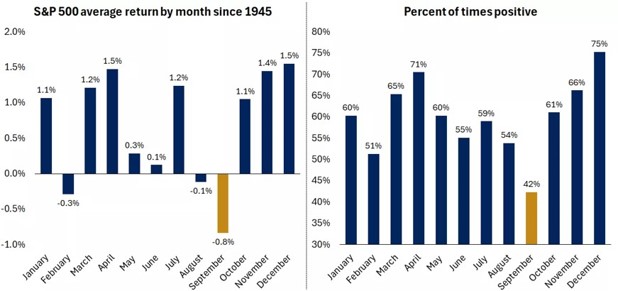
Statistics align with our cautious stance on Equities: September is historically the weakest month for stocks, with the lowest average returns and lowest probability of positive performance. Past September downturns typically coincide with weak economic fundamentals, whereas current growth, earnings, and financial conditions remain strong. However, macro uncertainty with Midterm election uncertainty can amplify seasonal weakness.
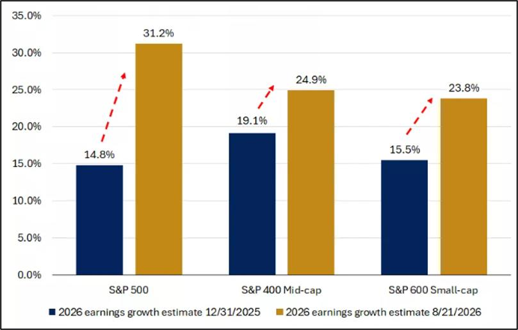
Valuation remains the dominant constraint. Q2 corporate earnings are tracking above 48% YoY growth, with full-year expectations at 31% revised upwards by more than 100% vs. market expectations at the beginning of the year. The next major earnings catalyst is not until mid-October, leaving a long window of vulnerability.
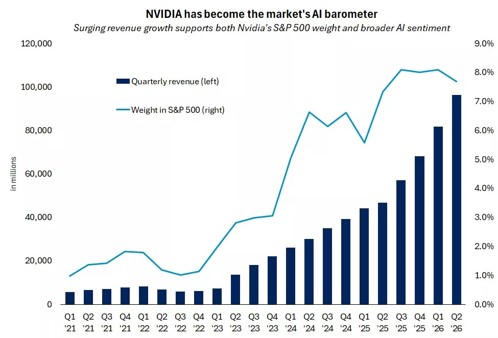
While AI capital spending remains high, investors are no longer rewarding spending alone. Markets are now demanding clear revenue and earnings returns on AI investments. Earnings gains span 10 of 11 sectors, led by Tech but also Energy, Communications, and Consumer Discretionary, slightly reducing market reliance on a few mega-cap tech giants. That being said, NVIDIA serves as the de facto barometer for the broader AI ecosystem, accounting for roughly one-third of tech sector profits, over 7% of total SCP 500 profits, and nearly 8% of the SCP 500 index weight.
Select Index and Sector Performance (August 2026)
Sector / Index
August 2026 Return
YTD Return (2026)
Primary Performance Drivers
S&P 500 (SPX)
+2.62%
+12.28%
AI infrastructure and mega-cap tech drove broad market recovery; energy strength benefited from geopolitical premium
Energy and industrial names up; consumer and travel stocks provided partial offset
Technology (XLK)
+6.36%
+29.54%
Broad tech remained positive; AI infrastructure (MRVL, COHR, ANET) materially outperformed the sector; mega-cap mixed
Healthcare (XLV)
+4.92%
+10.17%
Continued defensive rotation; managed care (CNC) showed notable strength; sector functions as quality refuge in volatile month
Consumer Discretionary (XLY)
+0.43%
-2.36%
De-escalation beneficiary; airlines (DAL), travel, and luxury (LVMH) began meaningful re-rating on lower fuel cost thesis
Energy (XLE)
+7.41%
+43.06%
Iran escalation risk premium expanding; Houthi attacks on Persian Gulf tankers; Strait of Hormuz supply concerns driving crude higher; major energy names outperforming significantly
VIX Index
-6.69%
-0.20%
Volatility structurally low creates exceptional opportunity for hedging
Commodities and Other Asset Classes
Energy: Strait of Hormuz Tensions Remain the Key Macro Driver for H2 2026
The energy market was the scene of dramatic and highly consequential developments in August. Brent crude oil opened the month near $79 per barrel, before spiking intramonth to a high of $94.81 as geopolitical escalation, triggered by U.S. threats of an indefinite naval blockade of Iran, renewed Strait of Hormuz anxiety and sparked intense short covering among bearish positions. While prices pulled back slightly in the final week as the market digested these friction points, Brent closed August at $88.28, representing a substantial gain from the start of the month. WTI followed a similar upward trajectory, closing the month at $84.53. Commercial shipping through the Strait of Hormuz has virtually collapsed since the conflict locked into its current phase, meaning that regional shipping insurance premiums remained highly elevated through the end of the month.
We have been consistent in our view that geopolitical risk premium is a structural driver of energy markets in H2 2026. This ongoing conflict, now in its sixth month, continues to threaten major supply corridors, making traditional energy positions highly volatile. OPEC+ maintained current production quotas at its late-August review, which has kept the floor under global crude prices solid. We recommend maintaining a selective posture on traditional energy equities, prioritizing operators with insulated supply chains and hedging exposure to short-term volatility.
Precious Metals: Gold’s Extraordinary August – Intramonth Peak and Structural Pullback
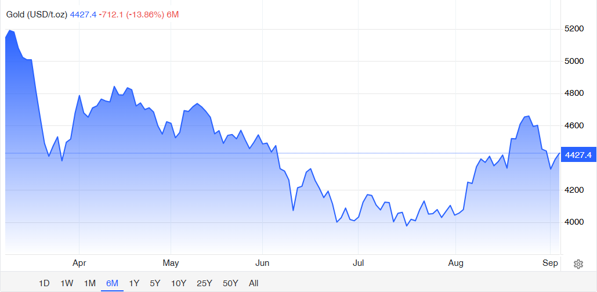
Gold delivered a strong performance in August. Spot Gold surged in the first half of the month as the combination of geopolitical risk, persistent central bank accumulation, and U.S. fiscal expansion concerns drove the price to an intramonth peak of $4,670.90 per ounce on August 24. This was followed by a moderate pullback as short-term traders took profits, with gold closing August at $4,455.24 per ounce. This is entirely consistent with our analytical framework that gold has two distinct demand drivers: the structural bid from emerging market central bank buying and fiscal diversification (which remains persistent), and the cyclical geopolitical safe haven bid (which fluctuates based on diplomatic news).
The minor pullback from the $4,670 peak to $4,455 reflects this cyclical component softening, not a structural reversal. The structural floor for gold has risen materially and we view the $4,200 to $4,300 range as the new key accumulation zone. Long-term targets remain highly achievable, supported by ongoing U.S. fiscal expansion and secular reserve diversification. Silver closed August at approximately $67.35 per ounce, having peaked above $71 earlier in the month, while long-term industrial demand expectations remain a key variable for the metal.
Industrial Metals, Digital Assets, and Other Classes
Copper prices surged to historic records in August, with LME three-month contracts trading above $14,000 per metric ton and Comex copper peaking at an all-time high of $6.83 per pound before settling near $6.59 per pound. This extraordinary rally has been driven by severe supply disruptions at major mines and critical inventory depletions in London warehouses, offsetting weaker economic data out of China. Copper continues to function as our preferred macro indicator, and its breakout suggests structural supply deficits are taking precedence over cyclical demand fears.
Bitcoin delivered a powerful bullish breakout in August, rallying from a start near $64,000 to close the month at approximately $78,548 per coin. This strong monthly recovery marks a reversal from the mid-year consolidation and positions Bitcoin favorably as it heads toward the final months of 2026. For risk-tolerant clients, we recommend holding spot ETF exposure (such as IBIT) and accumulating on brief pullbacks, as the risk-reward remains highly asymmetric on a 12 to 18-month view. For a more balanced exposure, our 90/10 Emerging Markets/Cryptocurrency, newly launched AMC, provides a balanced, safer allocation.
GOLD PRICE CHART
BRENT/WTI CHART
Market Outlook s Positioning
August 2026 has reinforced two convictions that should define portfolio positioning through the remainder of the year. The first is that broad equity markets at 20.1x forward earnings in a 4.65% rate environment offer materially asymmetric risk to the downside, and caution is not optional, but it is the analytically correct position. The second is that within this cautious posture, there are specific, high-conviction opportunities to position for a de-escalation scenario through structured instruments and selective cash equity ownership, in a way that manages downside risk while preserving meaningful upside participation. These two views are not contradictory; they define the framework for Q4 2026 positioning.
Cash: Maintain a 15-20% cash allocation. With T-bills yielding above 5%, cash continues to represent genuine positive real yield and the optionality to deploy at materially better equity levels. We are not reducing cash at these index levels. This is an active decision to preserve firepower for what we expect will be a more attractive entry point – either following a de-escalation-driven sector-specific re-rating or following a broader equity correction from current valuation levels.
Fixed Income: Core positioning in 3–5-year high-quality corporates and Treasuries (all-in yields of 4.18-5.2%) whilst selectively adding 7-10 year Treasury exposure as a conditional de-escalation hedge: if the Iran ceasefire framework advances materially, the disinflationary impulse from energy prices could accelerate Fed cut pricing and deliver 5-8% capital gains on this duration tranche. Avoid 30-year Treasuries and broad high-yield credit. Target 35-40% total fixed income weighting for balanced mandate.
Equities – Selective and Disciplined: We do not recommend adding broad beta exposure. The equity allocation should be tightly focused on: (1) AI Infrastructure quality compounders with fundamental earnings support – Marvell Technology (MRVL) (custom silicon / ASIC, hyperscaler diversification, structural growth) and Coherent Corp (COHR) (optical interconnects, AI bandwidth backbone, improving margins) represent our highest-conviction direct equity ideas;
(2) Luxury quality with rate and de-escalation optionality – LVMH (MC FP) remains attractive for quality-oriented mandates, offering best-in-class franchise strength at moderating valuations with multiple potential catalysts from rate cuts, de-escalation, and EM consumer recovery; (3) Defensive healthcare as a low-beta income anchor. Avoid broad index exposure, high-multiple speculative names, and all traditional energy equities exposed to sustained Hormuz tension.
Gold and Precious Metals: The August recovery to intramonth highs of $4,670 followed by pullback to the $4,200-$4,300 zone has created an attractive re-entry opportunity for clients who missed the original move higher or who took profits at prior peaks. We view $4,200-$4,300 as the new structural accumulation zone, with a 12-month target of $5,000-$5,200. The August pullback in gold from intramonth highs represents cyclical volatility against an unchanged structural demand backdrop; it is not a reversal of the longer-term bull market. Continue accumulating via physical gold, OUNZ/GLD ETFs, and potentially add via high-quality royalty companies (Franco-Nevada, Royal Gold) on dips. Silver warrants a satellite position at current historically wide gold-silver ratios.
Private and Real Assets: Inflation-linked infrastructure (toll roads, regulated utilities, and LNG terminals) remains a core allocation for clients with longer investment horizons and illiquidity tolerance. These assets continue to provide genuine inflation pass-through, with over 90% of listed infrastructure able to efficiently pass cost increases to end users through regulatory frameworks and long-term contracts. Data Centre real estate represents a distinct opportunity within the infrastructure category: the sector is experiencing an infrastructure investment Supercycle, with global capacity set to double between 2026 and 2030 and Data Centre REITs delivering strong operational momentum (Q1 2026 data center REITs averaged 29.4% funds-from-operations growth and 15.8% NOI growth year-over-year). Hyperscalers are dictating market pricing and contracting tenancy, with 80% of 2025 primary market developments pre-leased and 77% of the broader construction pipeline already committed with tenant agreements. Commercial real estate broadly deserves continued underweight, particularly office assets facing structural headwinds from hybrid work; however, select segments retain strategic merit. Industrial logistics, purpose-built data center facilities, and healthcare REITs with long-term lease structures (healthcare REITs showed positive absorption and cap rates near 6.38% as of H1 2026) and strong pricing power provide additional non-correlated income in defensive portfolios. Avoid legacy commercial real estate, regional malls, and unanchored properties; focus capital on assets with contractually protected cash flows and pricing power in inflation or technological growth scenarios.
Iran De-escalation: The Key Hedge and Upside Risk for H2 2026
The consensus remains long energy on geopolitical risk. There is downside risk if this positioning unwinds. The de-escalation scenario is not merely a trade to exit; it is a powerful framework for identifying what to own instead. However, the probabilities have shifted materially down. The June 17 US-Iran Memorandum of Understanding expired on August 17 with talks deadlocked; Iran has announced a shift to “fully offensive military posture” and conditional reopening of the Strait of Hormuz contingent on US sanctions relief, blockade removal, and compensation claims. If the ceasefire framework were to advance through Q4 2026 – now a lower-probability tail event – the market implications would be rapid and significant: Brent would retrace toward $75-85; core CPI could drop 30-50 basis points faster than currently priced; the Fed would restart its cut timeline; 7-10 year bonds would rally 5-8%; oil-importing EM equities would re-rate 10-15%; airlines and logistics would see operating leverage re-rating of 8-15%; and high-quality growth names (LVMH, luxury consumer) would benefit from both rate repricing and consumer spending power recovery. The key risks to this scenario remain Iran re-escalation (now elevated given recent posturing), a Fed surprise hike, or an AI capex disappointment that removes the remaining primary bull narrative for broad equities. Given elevated geopolitical tension and Hormuz closure extending through Q4, we recommend structured instruments and tactical hedges for de-escalation upside rather than outright equity long positions as the preferred vehicle for this low-probability, high-payoff scenario.