October was a month of two distinct halves. Equities opened the month at record highs on resilient technology leadership and a softer September jobs report that pushed back expectations of an imminent Fed hike, only to reverse sharply as AI-related names came under pressure, long-dated Treasury yields swung in a wide range, and the Federal Reserve held rates unchanged on October 28 after a contentious 10-2 vote. By month-end, the S&P 500 closed at 7,580, down -1.1% from September’s close, while the Nasdaq fell 6.9%, snapping its six-week streak of outperformance. The Dow bucked the trend, rising +1.7% as value and defensive sectors took the leadership from mega-cap growth.
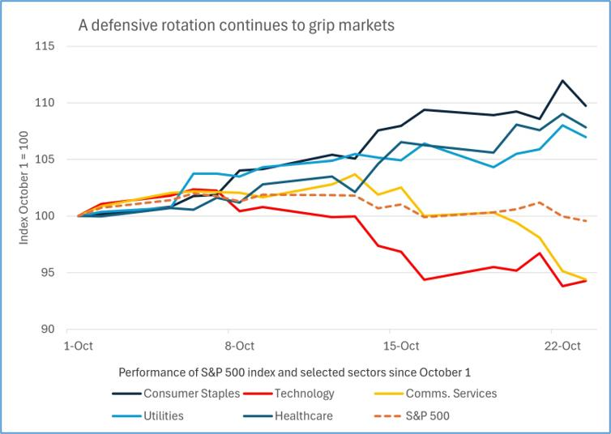
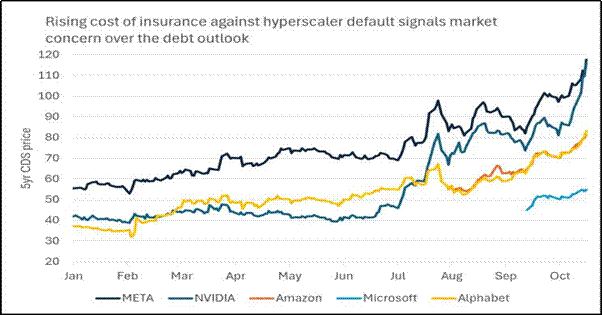
This was a month to actively manage concentration risk. The “AI trade” that powered markets through much of 2026 showed its first real cracks: Technology and Communication Services underperformed sharply from October 1 through month-end, while Consumer Staples, Healthcare, Utilities and Energy led a defensive rotation. Credit markets echoed the same message, with 5-year CDS spreads on several hyperscalers (Meta, Nvidia, Amazon) widening meaningfully as investors began pricing debt-funded AI capex more cautiously. Our baseline stance remains unchanged from September: a cautious broad-equity stance with active tilts in fixed income, disciplined commodity risk, and selective alternatives. The rotation seen in October reinforces, rather than contradicts, this positioning, which is further supported by volatility around mid-Term US elections.
Macroeconomic Review
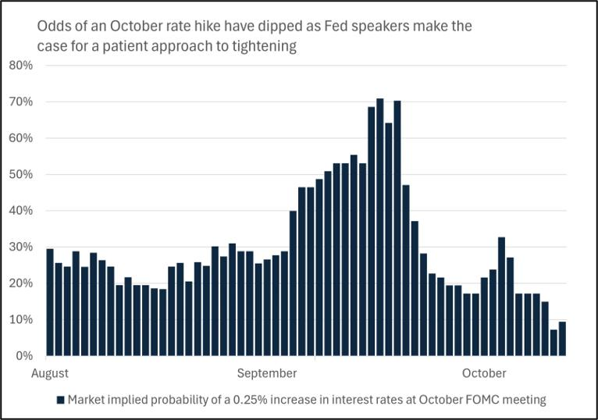
October’s macro narrative pivoted on rates expectations more than any other factor. Early in the month, a weak September payrolls print (+29,000 versus consensus of 80,000-90,000, with the prior two months revised down a combined 60,000) and an unemployment rate rising to 4.2% sharply reduced the probability of an October hike, from roughly 64% priced a week earlier to near 79% odds of a hold. Markets also took comfort from softer core PCE data (3.0% year-over-year in August, with the 3-month annualized rate touching 2.0%, the Fed’s target, for the first time in over two years).
Mid-month, the narrative reversed. September CPI came in at 3.7% annualized, up from 3.4%, while producer prices rose at a 6.3% annual rate, the highest since 2022. The 10-year Treasury yield, which had peaked near 5.3% in early October (the highest in more than two decades), subsequently eased back below 5.0% by October 22 for the first time in about a month, before settling at 4.9% by month-end as bond markets priced in a steadier path. The 2-year yield similarly declined from the high 4.8% to around 4.6% by month-end, its lowest level in over a month and a half.
Source: edwardjones.com
On October 28, the Federal Open Market Committee held its benchmark rate steady in a 10-2 vote, following September’s first hike since 2023. However, September’s PCE data released in the final days of the month showed inflation re-accelerating: headline PCE rose to 3.6% annualized (from 3.4%) and core PCE to 3.1% (from 3.0%), both well above the Fed’s 2.0% target. Markets responded by showing roughly 73% probability of a quarter-point hike at the December 9 meeting. Growth data, meanwhile, surprised to the upside: Q3 GDP’s initial estimate came in at an annualized 3.4%, well above the 3.1% consensus and up from Q2’s upwardly revised 2.2%.
The economy is running hotter than the disinflation narrative assumed, and the Fed is now navigating a genuine two-sided risk between still-elevated inflation and a softening-but-not-broken labor market. This argues for continued discipline in duration positioning and skepticism toward a swift return to easy policy.
Fixed Income
October delivered the long-awaited relief on duration that had eluded investors through most of the third quarter.
Maturity
2ndOct 2026
16thOct 2026
30thOct 2026
2 years
4.83%
4.74%
4.58%
5 years
5.06%
4.90%
4.72%
10 years
5.28%
5.10%
4.93%
30 years
5.63%
5.44%
5.31%
Historical context remains supportive for income-oriented, intermediate-duration positioning: with the Bloomberg U.S. However, Credit Markets flagged early-stage AI-financing concerns: 5-year CDS spreads for Meta, Nvidia, Amazon and Alphabet widened steadily through October as investors grew more attentive to hyperscaler leverage tied to data-center capex.
Fixed Income Positioning Summary (October 2026)
Segment
Recommendation
CIO Commentary
Key Risk
U.S. T-Bills (3-6M)
OVERWEIGHT
Still the best liquidity-adjusted carry; preserves optionality as rate-path uncertainty into December persists.
Reinvestment risk should the Fed pause longer than priced.
U.S. Treasuries (2-5Y)
OVERWEIGHT
Belly captured the bulk of October’s yield decline; still the most attractive carry-to- duration trade-off.
A hawkish December hike repricing could reverse recent gains.
U.S. Treasuries (7-10Y)
NEUTRAL / TACTICAL ADD
The dip below 5.00% in late October validated patient accumulation; remain selective on further rallies.
Resurgence of inflation data (as seen with September PCE) could reverse the rally quickly.
U.S. Treasuries (30Y)
UNDERWEIGHT
Despite the October retracement to the low-5.20s%, term premium and fiscal supply risk remain structurally elevated.
Widening hyperscaler CDS spreads could spill into broader IG sentiment.
High Yield
UNDERWEIGHT
Compensation remains insufficient given refinancing and late-cycle default risks.
Tech-related credit stress spreading to lower-quality issuers.
Equity Markets
October marked the sharpest style and sector rotation of the year. From the record highs set in early October, the Nasdaq 100 fell 6.9% for the month as AI-related mega-caps and chipmakers came under sustained selling pressure. The rotation was stark at the sector level: from October 1 through month-end, Consumer, Healthcare, Utilities and Energy led, while Technology and Communication Services lagged materially. The Dow, with its heavier weighting in value and industrial names, was the only major index to post a positive October, rising +1.7%.
Importantly, this was not solely a valuation story. Earnings season, now more than halfway complete, continued to validate the broader market: analysts raised full-quarter S&P 500 earnings growth expectations to roughly 30.2%, which would mark a third consecutive quarter above 25% growth. However, the composition of that growth shifted meaningfully. For the first time this cycle, the “Magnificent Seven” group reported lower earnings growth (around 22.6%-33.6%, depending on the measurement date) than the other 493 S&P 500 companies (around 27.8%-32.6%), with several mega-caps including Meta missing EPS estimates despite strong headline revenue, triggering outsized single-day declines.
Our core message from September stands and was reinforced by October’s price action: concentration risk in AI-adjacent mega-caps is real and should be actively managed, not ignored because of strong index-level returns. We continue to favor quality franchises with durable earnings and balance-sheet resilience over chasing narrow AI-infrastructure leadership, and we view the broadening of earnings growth beyond the Magnificent Seven as a constructive, if underappreciated, development for market breadth heading into year-end.
Select Index and Sector Performance (October 2026)
Sector / Index
October 2026Return
YTD Return(2026)
Primary Performance Drivers
S&P 500 (SPX)
-1.1%
+10.6%
Closed October at 7,580: record highs early in the month gave way to a tech-led pullback.
Nasdaq Composite (IXIC)
-6.9%
+11.5%
Snapped a six-week outperformance streak; AI infrastructure and chipmaker selling drove the sharpest monthly decline since the AI-led rally began.
Dow Jones (DJIA)
+1.7%
+8.3%
Sole major index to post monthly gains; benefited from a value/defensive rotation away from mega-cap growth.
Technology (XLK)
-9.3%
+24.7%
Worst-performing sector in the October rotation; sharp CDS widening for hyperscaler added to the de-rating.
Healthcare (XLV)
+11.2%
+20.1%
Leading defensive sector of the month as investors rotated out of growth and into earnings-stable names.
Consumer Discretionary (XLY)
+6.0%
-2.0%
Rebounded from September weakness as part of the broad sector rotation.
Energy (XLE)
+11.7%
+49.2%
Benefited from an 8%+ oil price swing higher mid-month on Middle East supply concerns.
Russell 2000
+0.2%
+14.1%
Stabilized relative to September’s sharp decline as falling short-end yields provided some relief.
VIX Index
+18.9%
+29.2%
Moved from the mid-teens to the high-teens as the technology sell-off and Fed decision reintroduced two-way volatility.
Commodities and Other Asset Classes
Energy
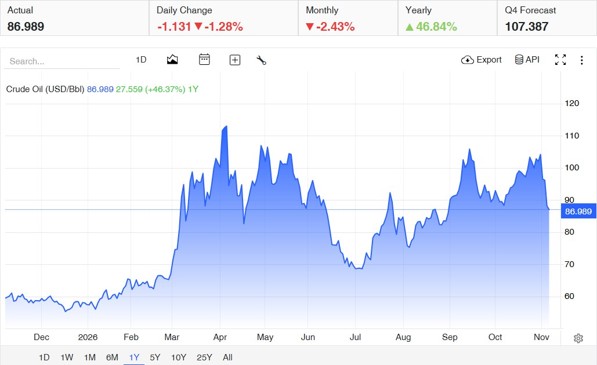
Oil remained the most volatile major asset class in October. WTI began the month near $90, fell further toward the high-$80s/low-$90s in the first half, then surged more than 8% in a single week on Middle East supply uncertainty and a larger-than-expected U.S. crude stockpile drawdown, briefly moving back above $100-104 per barrel. Prices subsequently whipsawed between roughly $98 and $104 before settling near $100-101 by month-end, a cumulative two-week gain of around 12% at one point. Brent followed a similar pattern, touching the $114-115 range intramonth before easing to around $110 by month-end. This confirms our continued view that energy exposure should be sized tactically with explicit scenario planning rather than held as a structural overweight.
Precious Metals
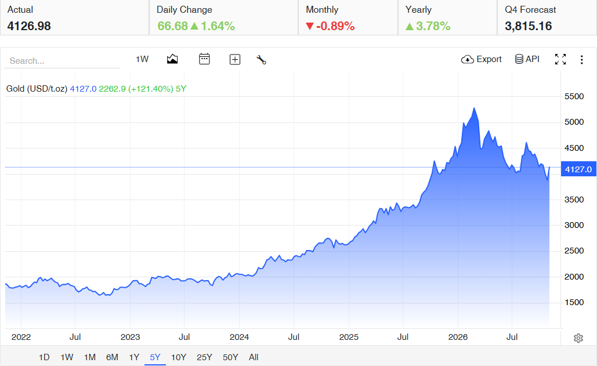
Gold had a difficult month, falling from around $4,175- in early October to $3,900 by month-end, a decline of -5.8%, as the partial retracement in real yields and a resilient dollar weighed on the metal despite ongoing geopolitical risk. The move validates our September caution that gold’s role is best framed as a policy and geopolitical hedge rather than a momentum trade; the downside floor we highlighted around $4,000-4,200 was tested and, at month-end levels, breached. We would look to reassess accumulation levels closer to the $3,800-3,900 zone should the decline stabilize, while continuing to treat gold primarily as a diversifying hedge rather than a directional position.
FX and Digital Assets
The U.S. Dollar Index eased modestly through October, from around 102.3 to roughly 101.7, as the softer-than-expected October rate path reduced some of the dollar’s yield advantage, though it remains up materially year-to-date. Digital assets had a weak month: Bitcoin fell from the mid-$80,000s to around $78,000 (down roughly 9%-10% over the period), while Ethereum declined from the mid-$2,500s to around $2,280 (down approximately 11%-16%), reinforcing our view that these remain tactical risk assets rather than core macro hedges within balanced mandates.
Market Outlook and Positioning
Our November starting point remains a defensive but opportunistic allocation framework, with one key adjustment following October’s rotation:
Cash/Liquidity: Maintain above strategic neutral; the December Fed decision and ongoing earnings dispersion argue for continued flexibility.
Fixed Income: Maintain overweight front-end and intermediate quality exposures; the October rally in the belly of the curve validated this positioning, and we would selectively extend duration on further valuation dislocations in the 7-10Y segment.
Equities: Retain a cautious broad-beta stance, but actively reduce concentration in AI-infrastructure mega-caps; favor the broadening earnings base among the “other 493” S&P 500 companies and quality defensive/value names that led October’s rotation.
Commodities: Continue to treat energy as tactical with potential downside risk; reassess gold accumulation levels nearer $3,800-3,900 should the correction stabilize.
Alternatives: Focus on transparent structures with clear downside maps and genuine diversification utility, particularly given rising credit-market attentiveness to hyperscaler leverage.
US Midterm Elections
The US midterm elections resulted in a Democratic victory in both the Senate and the House of Representatives, creating a divided government for the remainder of President Trump’s term. While the outcome strengthens the Democrats’ ability to scrutinise the administration’s policies and influence legislative discussions, the President retains executive powers and the ability to veto legislation. Consequently, significant policy changes are expected to be constrained, although increased political scrutiny and legislative uncertainty are likely.
Potential market impact: In the near term, the outcome may lead to greater regulatory scrutiny, particularly for technology and AI companies, alongside increased oversight of the banking and healthcare sectors. Clean energy and related infrastructure may receive comparatively favourable policy attention. For fixed income, political gridlock could limit the introduction of further large-scale fiscal spending measures, although the upcoming debt-ceiling discussions may create periods of market volatility. The US dollar and precious metals may remain influenced by broader monetary policy, fiscal concerns and investor sentiment rather than the election result alone.
The immediate market response was relatively contained, with initial equity-market weakness largely reversing as investors assessed the implications of the result. Over the coming weeks, attention is likely to remain on potential regulatory developments, particularly around AI infrastructure and data-center expansion, as well as fiscal negotiations and the debt ceiling. Overall, the election is expected to increase policy uncertainty rather than trigger an immediate change in the broader economic outlook.