September marked a clear transition from rate-risk concern to rate-regime reality. The U.S. Federal Reserve delivered its first hike since 2023, policy expectations repriced higher across the curve, and global long-duration assets absorbed another month of valuation pressure. At the same time, equity indices held up better than many expected, but underlying performance narrowed further toward growth and quality, while small caps and rate-sensitive segments lagged.
This was a month to protect flexibility, improve portfolio carry quality, and tighten selectivity standards. Our baseline remains a cautious broad-equity stance with active tilts in fixed income, disciplined commodity risk, and selective alternatives where payoff asymmetry is demonstrably favorable. For the month, the S&P 500 closed at 7,651, a decline of -0.5% from August’s close of 7,365. The Nasdaq Composite moved +1.7% to 26,861, once again outpacing the broader index as AI infrastructure and mega-cap growth names retained leadership, while the Dow Jones Industrial Average lost -4.1% closing at 50,906. As in August, headline index strength masked a narrower internal breadth, with small caps and rate-sensitive segments lagging materially as the Fed’s September hike repriced the front end of the curve.
Macroeconomic Review
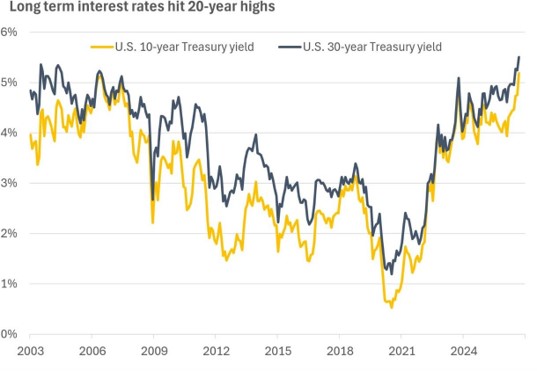
September’s macro sequence unfolded in three phases. Early month, strong labor data and sticky inflation kept hike risk elevated. Mid-month, CPI and producer inflation data reinforced a higher-for-longer policy path. Late month, the market digested both the Fed hike and a continued climb in long-term yields, with the U.S. 10-year ending around 5.16%-5.18% and the 30-year near 5.49%-5.50%.
Importantly, this was not only a U.S. rates move. Major developed-market sovereign yields also moved higher, confirming that the repricing pressure is global and linked to persistent inflation uncertainty, resilient activity, and central banks’ unwillingness to signal early easing.
Our interpretation is straightforward: policy is now explicitly restrictive, growth is slowing only gradually, and inflation is decelerating too slowly to justify immediate duration extension at scale. This combination argues for disciplined risk budgeting, not broad directional bets.
Navigating a Higher Interest Rate World
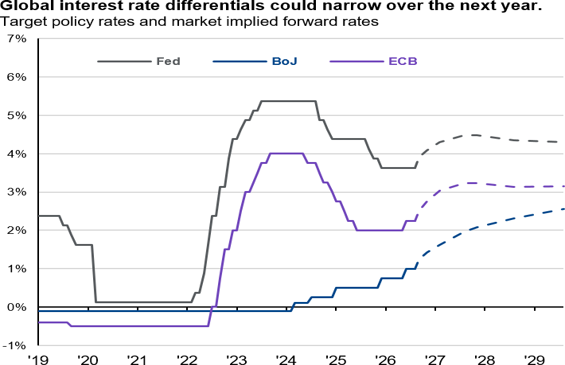
Central Banks Convergence Towards 3% Target Policy Rates
Fixed Income
The fixed income message in September was clear: carry improved, but duration pain remained real. The front end and belly continued to offer attractive all-in yields, while long-end volatility stayed elevated and vulnerable to term-premium expansion.
We continue to favor high-quality 1-5 Year exposures where the income buffer is meaningful and mark-to-market risk is more manageable versus 10+ year tenors. In credit, selectivity matters more than spread beta. Quality balance sheets, resilient free-cashflow profiles, and prudent refinancing ladders should be prioritized over headline yield.
Fixed Income Positioning Summary (September 2026)
Segment
Recommendation
CIO Commentary
Key Risk
U.S. T-Bills (3-6M)
OVERWEIGHT
Best liquidity-adjusted carry and high optionality for tactical redeployment.
Reinvestment risk if disinflation accelerates abruptly.
U.S. Treasuries (2-5Y)
OVERWEIGHT
Strong carry-to-duration ratio, better convexity profile than long end.
Another hawkish repricing wave.
U.S. Treasuries (7-10Y)
NEUTRAL / TACTICAL ADD
Useful hedge if growth slows faster; add only on clear valuation dislocations.
Persistent higher-for-longer narrative.
U.S. Treasuries (30Y)
UNDERWEIGHT
Term premium and fiscal supply risk remain dominant.
Further long-end yield breakout.
IG Corporate (3-5Y)
OVERWEIGHT (SELECTIVE)
Prefer quality spread capture over aggressive spread compression bets.
Risk-off spread widening.
High Yield
UNDERWEIGHT
Compensation remains insufficient versus refinancing and downside-cycle risks.
Late-cycle default repricing.
Equity Markets
Equity index behavior in September appears constructive at first glance, but market internals remain cautionary. Outperformance stayed concentrated in growth, with Nasdaq outperforming while small caps underperformed and broader participation remained uneven.
Our core equity message remains unchanged: do not add broad beta aggressively at current valuation and rates combinations. Instead, keep exposure concentrated in quality franchises with earnings durability, strong cash conversion, and balance-sheet resilience. The opportunity set exists, but it is selective, not index wide.
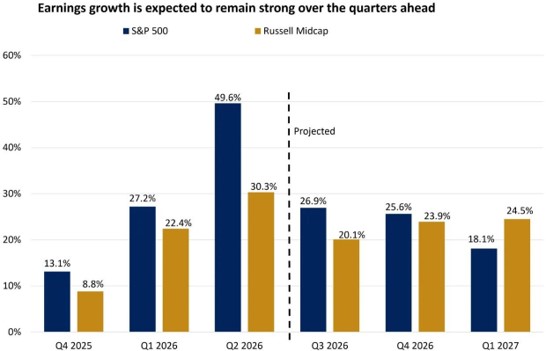
The Q3 reporting season kicking off in October is expected to confirm record numbers, therefore focus will be on outlook for Capex and Margins, especially from the hottest names in Tech.
Select Index and Sector Performance (September 2026)
Sector / Index
September2026 Return
YTD Return(2026)
Primary Performance Drivers
S&P 500 (SPX)
-0.5%
+11.7%
Closed September at 7,651.54 vs. 7,686.14 in August; resilient despite the Fed hike, but performance concentrated in quality growth and AI infrastructure names
Nasdaq Composite (IXIC)
+1.7%
+18.4%
Outperformed on continued AI infrastructure and mega-cap tech strength ahead of Q3 earnings
Dow Jones (DJIA)
-4.1%
+6.6%
Weakest month since March; cyclicals and rate-sensitive industrials weighed heavily on the index
Technology (XLK)
+4.5%
+34.0%
Finished the month within 1% of all-time highs; AI infrastructure names remained the dominant driver ahead of Q3 Capex/margin commentary
Healthcare (XLV)
-1.3%
+8.9%
One of nine of eleven sectors to finish lower; defensive rotation only partly offset broader rate-driven pressure
Consumer Discretionary (XLY)
-5.7%
-8.0%
Mixed; airlines and travel softened on oil volatility, partly offset by a luxury re-rating
Energy (XLE)
-5.0%
+37.5%
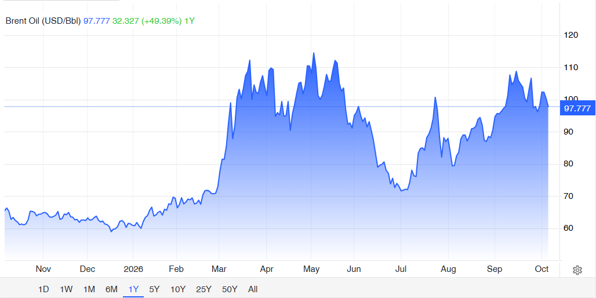
Highly volatile; swung with oil’s move from above $100 to the low-$90s on shifting geopolitical headlines
Russell 2000 (Small Caps)
-5.3%
+13.9%
Biggest monthly decline since the March 2025 tariff tantrum; most exposed to the Fed’s hawkish repricing and higher short-end rates
VIX Index
+9.5%
+9.3%
Rose from ~14.9 to ~16.3 as the Fed hike and long-end yield moves reintroduced two-way volatility off multi-year lows
Commodities and Other Asset Classes
Energy
Oil remained event-driven and highly volatile. September saw a swing from above $100 to low-$90s as geopolitical headlines shifted. This confirms our view that energy should be handled tactically, with strict position sizing and explicit scenario planning.
Precious Metals
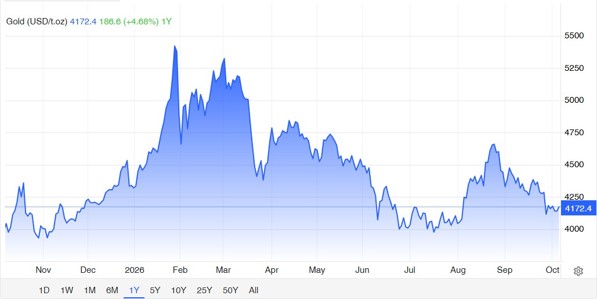
Higher real-rate pressure weighed on gold into late September. For strategic allocators, we still view gold primarily as a policy and geopolitical hedge rather than a short-term momentum trade.
FX and Digital Assets
The U.S. dollar remained firm on policy-rate differentials and relative growth resilience. In digital assets, upside bursts continued but should be treated as tactical risk assets, not core macro hedges, inside balanced mandates.
Market Outlook and Positioning
Our October starting point is a defensive but opportunistic allocation framework:
Cash/Liquidity: Keep above strategic neutral to preserve flexibility in a high-volatility rates regime.